Customer problem
Customers were largely unaware of the platform’s growing AI capabilities and could face new cognitive load at entry.

Featured case study
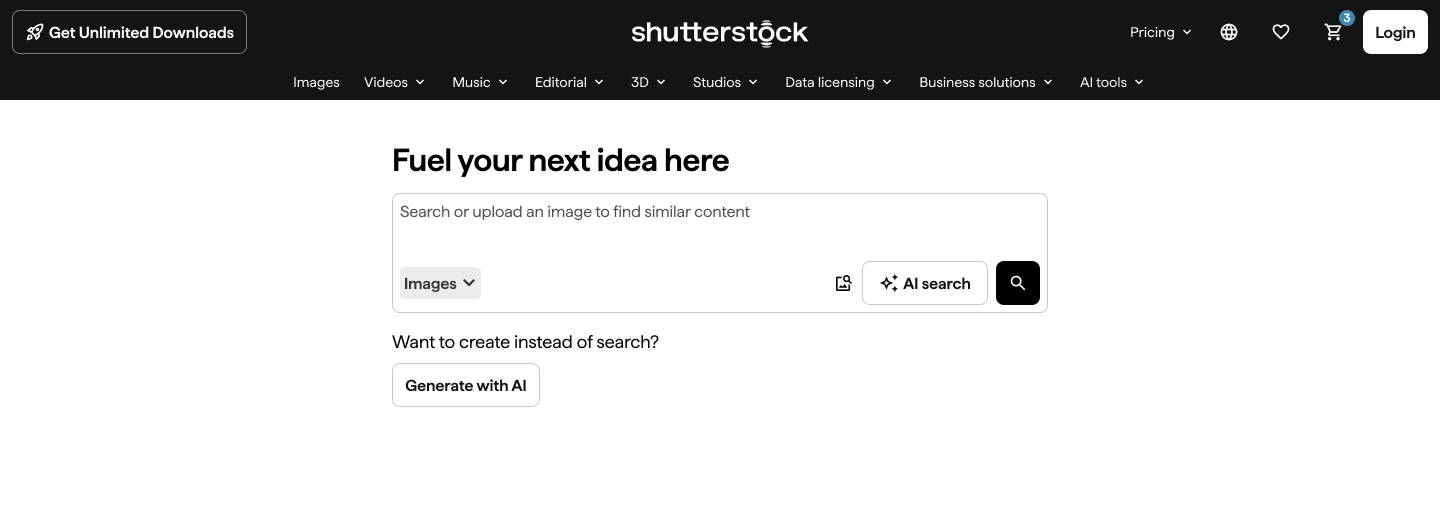
Shutterstock had grown beyond traditional stock search, but its homepage still communicated a single-product marketplace. AI Search and Generate introduced new ways to begin creative work, while the familiar search experience remained central to existing customers.
With one month to complete design before an impending merger, I owned the homepage hero and designed the Creative Command Bar: one entry point connecting Search, AI Search, and Generate. The launch made Shutterstock’s broader platform visible, but it also reduced homepage search starts. The first release became evidence for a clearer next iteration.
Three distinct creative workflows needed one understandable starting point.
Fewer homepage visitors chose to begin search after launch.
For logged-in users who did search, downstream behavior remained near the 75.1% pre-launch rate.
Make a broader platform understandable without weakening what customers already trusted
The homepage needed to support Shutterstock’s “Never Start From Scratch” campaign and communicate that licensed content and AI could work together. At the same time, introducing multiple ways to begin risked making the familiar search action harder to recognize.
Customers were largely unaware of the platform’s growing AI capabilities and could face new cognitive load at entry.
Leadership wanted the homepage to signal a meaningful shift while supporting consideration and content revenue.
One historically dominant workflow now had to coexist with two newer mental models.
Owning the primary interaction while navigating product ambiguity
I collaborated most closely with the lead designer as three designers explored overall page structures. With limited product-management ownership, Design drove the process and stakeholder alignment. I personally owned the hero, its image animation, and the interaction model behind the Creative Command Bar.
The opportunity was clearer entry, not more capability
Competitive analysis, unmoderated usability testing, prototype validation, and analytics helped separate what customers understood from what they overlooked.
Participants consistently completed familiar search tasks successfully. The redesign could not afford to obscure that strength.
The new interaction needed stronger explanation and a more legible relationship to standard search.
Discoverability was the larger problem for generative AI, not desirability.
Only two of six participants naturally entered through the hero, focusing the redesign on visual hierarchy, affordance, and expectation setting.
Three creative workflows. One starting point.
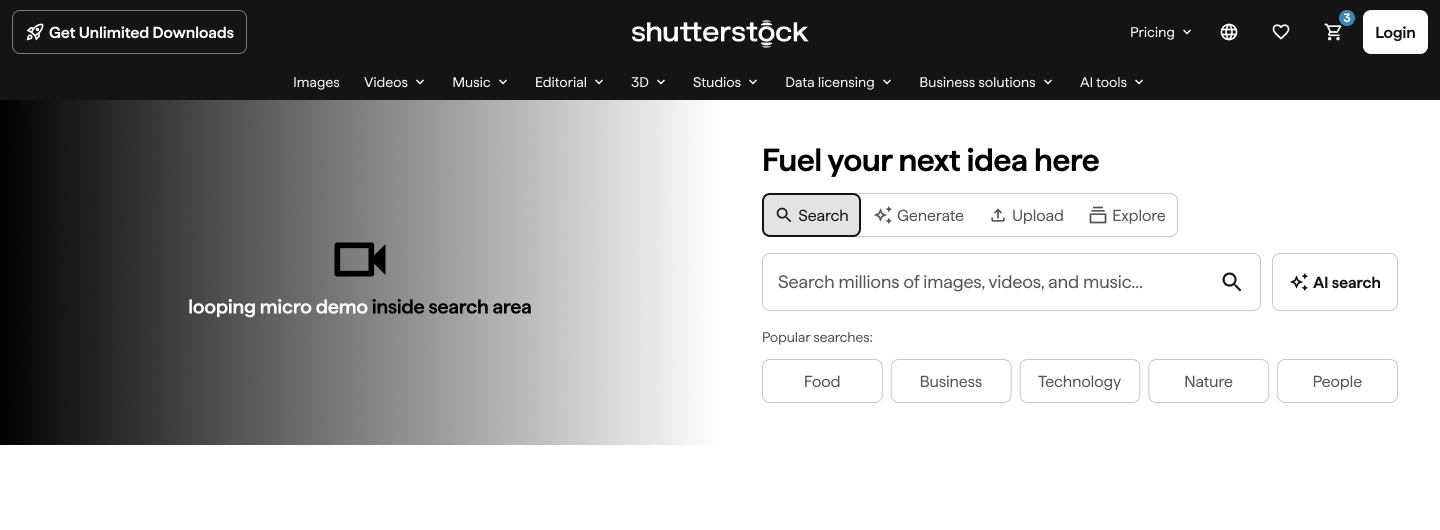
The Creative Command Bar gave each workflow a distinct purpose while maintaining a shared interaction model across the homepage.
Discover existing licensed content through the platform’s most familiar workflow.
Explore with natural language and refine intent iteratively.
Create new content with AI while remaining connected to the broader platform.
Traditional search remained immediately recognizable so existing customers would not feel displaced by the new platform story.
Additional functionality appeared through interaction rather than competing for attention at first glance.
The three modes communicated different starting points without appearing to be separate products.
Shared patterns reinforced that customers were still operating inside one creative platform.
Exploring breadth before converging on the interaction model
Three designers independently explored low-fidelity page structures before aligning with stakeholders on section order. We then compared medium-fidelity concepts by development effort and moved into high-fidelity hero iterations, unmoderated testing, and interactive prototypes.
I also proposed a “guided start” narrative: first help customers begin, then show what that starting point could become. Parts of that concept informed the final page, although the broader narrative combined ideas from multiple directions.

Delivering a visible platform shift in one month
The first release had to communicate “Shutterstock has changed” while leaving Engineering enough time to build before the merger. That urgency made scope discipline as important as concept quality.
Hero image and page-load motion were simplified to protect delivery time and implementation quality.
The Creative Command Bar could not yet support image or document input.
The final page adapted to constraints in the existing publishing model.
Each tab received a distinct personality without exposing every possible control upfront.
The launched homepage made multiple creative workflows visible from a single starting point. Search remained present, while AI Search and Generate established a new platform narrative supported by updated content hierarchy and richer visual storytelling.
The platform story became broader, but the primary action became less obvious
Three weeks after launch, homepage search events had moved from 93.8K pre-launch to 73.0K, and the page search rate declined from 13.68% to 9.62%. AI Search remained extremely small, while Generate and Edit increased from 114 to 205 events from a very small base.
The downstream picture was more nuanced. For logged-in users who did begin search, search-to-asset-detail behavior remained stable: 75.1% before launch and 75.6% in week three. Search quality did not appear broken; fewer people were choosing to start from the homepage.
These figures were an early directional read, not a final attribution study. The strongest working hypothesis was that the hero asked customers to process too many paths at once.
The homepage was not only a marketing surface; it taught customers how Shutterstock’s products related to one another. The project reinforced that expanding product perception and protecting task clarity must be evaluated together.
Explore more work
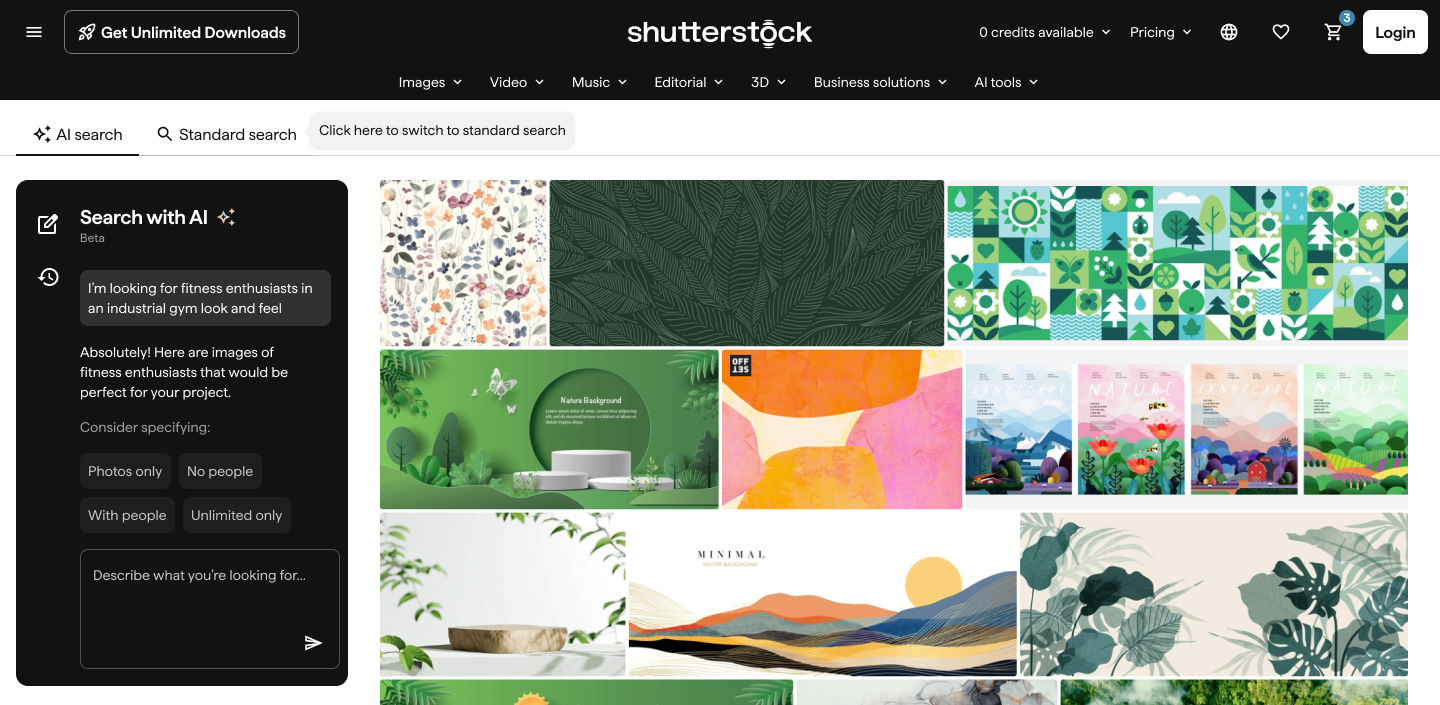 Building conversational searchLearning where AI fits within an established marketplaceView case study
  Turning Studios into a credible sales toolAligning an expanded offer with a scalable digital foundationView case study
 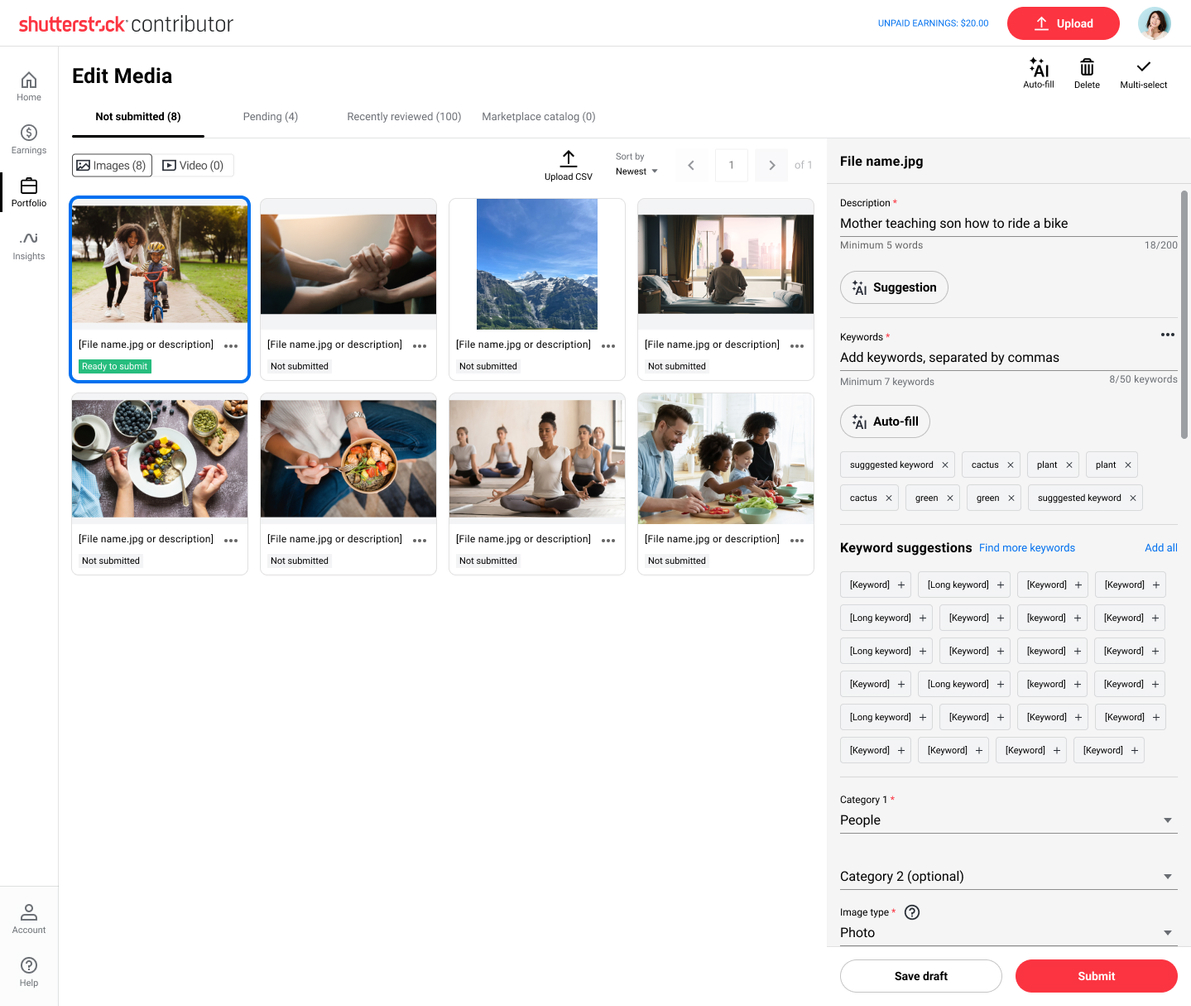 Increasing submission velocityReducing workflow interruption with AI-assisted metadataView case study