Customer problem
Strict keyword matching created unguided search loops, especially when customers started with conceptual or ambiguous creative needs.

Featured case study
Shutterstock customers often began with creative briefs, moods, and conceptual ideas that did not map cleanly to keywords. I inherited an early AI Search concept and independently led a six-month rebuild across the marketplace.
Early experiments showed a 2.3% conversion lift, but post-launch behavior revealed a more nuanced outcome: AI Search helped some customers express intent, yet most licensing still happened through traditional search. The project became as much about designing the handoff between search models as designing the AI experience itself.
Promising result from early conversational search experiments.
AI Chat Search remained a niche path within marketplace search.
Customers frequently used AI for exploration, then licensed through the familiar search flow.
Let customers describe intent instead of translating it into keywords
Shutterstock search asked customers to compress moods, concepts, and project briefs into exact keyword queries. Weak initial queries produced irrelevant results, repeated searches, and a slower path to licensing.
Leadership saw conversational AI as a way to reduce cognitive load, improve relevance, and differentiate the marketplace. It also addressed search friction affecting time to value, customer retention, and revenue.
Strict keyword matching created unguided search loops, especially when customers started with conceptual or ambiguous creative needs.
Low-quality searches increased acquisition friction and slowed customers from finding content they were confident licensing.
AI Search had to work across the homepage, search results, and product pages without making customers guess which search model to use.
Taking the project from early validation to launch
I inherited an initial workshop and concept from another designer. After that handoff, I owned the product design process independently: interaction design, research, prototyping, facilitation, stakeholder alignment, and implementation support.
I partnered with the product manager and engineering team while aligning direction with the VP of Design, Senior Director of Engineering, and Director of Marketplace.
Designing an ambitious interaction model within launch realities
The experience needed to feel modern and useful even though the first release had meaningful technical and scope limitations.
Search results took too long to load. Engineering improved performance before launch. The interface also used additional progress animation to make the remaining wait easier to understand.
The launch supported images and video only. Multimodal prompting with reference images or documents remained out of scope.
The system could not preserve conversational memory beyond five chat responses, limiting the depth of iterative exploration.
When customers did not specify image or video, the system defaulted to image results so the experience could continue without another blocking question.
Clarifying how AI should fit into familiar search behavior
I used unmoderated usability studies, sentiment research, and interactive Figma Make prototypes to test how customers understood the chat experience, moved between AI and standard search, and interpreted transitional states and animation.
Design the relationship between search models, not a standalone chatbot
Four decisions connected conversational search to the marketplace journey and protected the workflows customers already trusted.
AI and standard search remained available side by side. Tabs supported direct switching and preserved the current search context, so customers did not need to start over when changing modes.
I moved away from a ChatGPT-style thread and designed a split workspace with chat on the left and the asset grid on the right. Customers could refine language while continuously evaluating content.
Viewing an asset originally created a new chat and erased the prior search. I changed the flow so customers could move between AI results and product pages without losing conversation state.
The first release supported editing and copying prompts, force-stopping responses, feedback ratings, chat history, and reuse of earlier searches. This provided enough control to feel familiar without expanding every history-management feature.
Turning exploration into a buildable product direction
I facilitated explorations with Engineering to understand what the system could support. I then used research and interactive prototypes to make behavior, animation, and tradeoffs tangible for product and leadership stakeholders.
This shifted conversations away from abstract opinions about AI and toward observable customer behavior, technical feasibility, and the marketplace journeys the team needed to protect.
The launched experience added conversational discovery to Shutterstock’s universal search while keeping it connected to the marketplace. Customers could describe intent naturally, evaluate assets beside the conversation, refine prompts with familiar controls, revisit prior searches, and inspect product details without losing context.
A promising experiment did not become a primary licensing path
Early tests showed conversion potential, but post-launch behavior was more mixed. AI Chat remained a niche exploration tool, and most commercial behavior still happened through traditional search.
AI Chat users generated a 0.15% order rate versus 0.1% for traditional search, but only 136 orders were observed. This was too small a quantity to treat as a reliable success signal. Usage also skewed toward returning visitors. First-time visitors represented 36% of AI Chat users versus 58% of traditional search users.
The strongest learning was that customers did not need AI Search to replace traditional search. They needed it to help express intent, then hand off cleanly to the marketplace workflow that already supported confident licensing.
Explore more work
 Redefining Shutterstock Studios’ digital presenceAligning an expanded creative offer with a scalable digital foundationView case study
  Repositioning Shutterstock for the AI eraUnifying Search, AI Search, and Generate in one starting pointView case study
 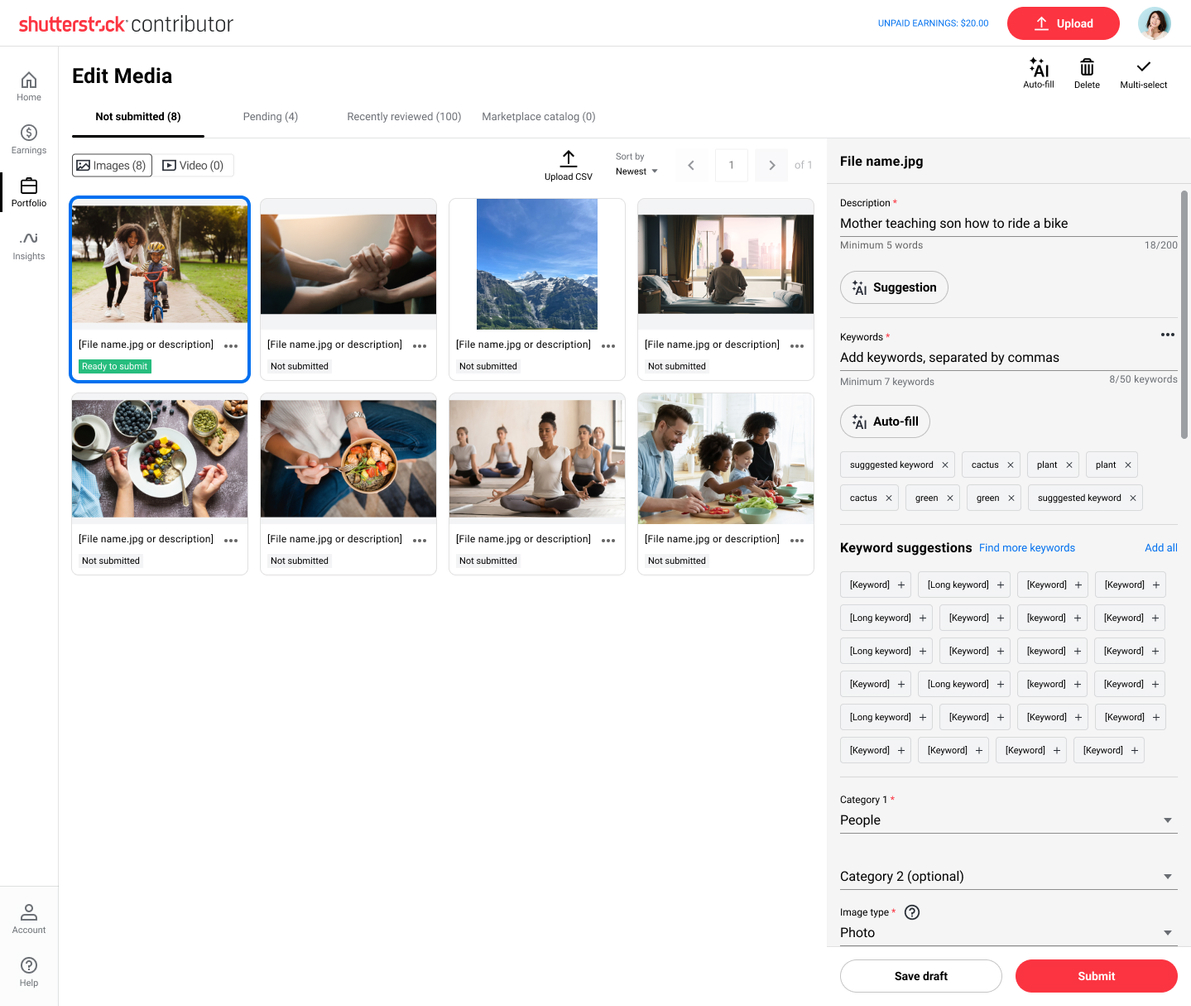 Increasing submission velocity by 23%Using AI-assisted workflows to drive 27% library growth in the measured timeframeView case study